|
The all-weather
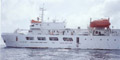
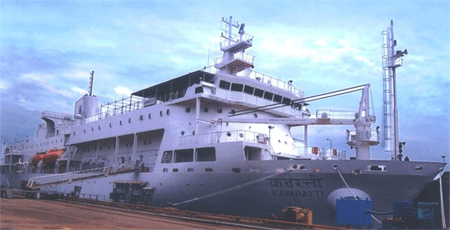
passenger ship, m.v. Kavaratti, built for the
Lakshadweep administration by Hindustan
Shipyard, Visakhapatnam, will make its maiden
voyage to the islands in the first week of
August, 2008.
The Rs.173-crore ship, an engineering marvel is
120 Meter long and has a speed of 17 Knots. The
ship can carry 700 passengers and 200 tons of
cargo. The
ship has world-class facilities like a
152-seater cafeteria, 100-seater dining hall,
Recreation room, gymnasium and a very large airspace
to enhance passenger convenience on-board. The
ship is fully Air conditioned by centralized
air-conditioning system and has been built to
world class standards.
 Ship
facilities include three independent Galleys,
Halls, Recreation place with a swimming pool and
helipad. The ship has 200 first class seats and
200 second classes. Ship
facilities include three independent Galleys,
Halls, Recreation place with a swimming pool and
helipad. The ship has 200 first class seats and
200 second classes.
“M.V.Kavaratti is a fine piece of work created
by our workforce. This is the first of its kind
built by any yard in the country with own
designing. The vessel has 300 km of wiring and
50 km of pipeline with delicate craftsmanship
which typify the scale in which it has been
built,” says Rear Admiral Ajit Tewari, HSL
Chairman and Managing Director.
The ship was designed and built by Hindustan
Shipyard Ltd (HSL) located in the port city of
Visakhapatnam on the East coast of India. HSL is
a fully owned Government of
India Undertaking, under the Administrative
control of the Ministry of Shipping, Road and
Highways.
the largest passenger vessel ever built
one of the great engineering achievements
Eventually, luxury cruises took high-ticket
passengers through the Canal. Gradually, the
trip became accessible to anyone with a block of
vacation time and a modest vacation budget.
size and weight of the ship helped solve the
problems of rough seas or bad weather. And its
ability
-----
Facts for the Travellers to Lakshadeep Islands
Location Tourist Season
400 Kms off the coast of Kerala October to end
of April
Getting there Climate
Indian airlines flies a 14-seater Dornier
aircraft daily from Kochi ( cochin ) to Agatti
island, except on sundays
Ships ply from Cochin to Agatti island according
to a published schedule Temperatures range from
27 - 32 degree celsius ( 80 - 89 degree
Fahrenheit )
Water temperature ranges from 25 - 30 degree
celsius ( 77 - 86 degree Farenheit )
Monsoon
June to September
Things to do
Scuba diving
Kayaking
Island excursions
Snorkeling
Speed boating
Glass bottomed boat sail
Para Sailing
Deep sea fishing
Lagoon fishing
Sail boating
----------
complete information on how to reach the islands
of Lakshadweep.
-----
The flying time between Agatti and Kochi
(Cochin) is only one hour and a half. From
Agatti you can find helicopter services to reach
Kavaratti (an important city in the region)
round the year and Bangaram Island in the
monsoons.
How to reach the islands of Lakshadweep by Sea:
Traveling by ship is also a good option to reach
Lakshadweep. A number of passenger ships operate
from Kochi (Cochin)to Lakshadweep. The distance
can be traveled in nearly 18 to 20 hours. The
ships offer a range of accommodation and modern
amenities. However, during the monsoons, the
ship services remain closed.
--
TO ease the transportation problem of islanders,
the Lakshadweep Administration is planning to
charter a ship between the islands and the
mainland in a couple of months.
Participating in a meet the press programme at
the Press Club here, the newly appointed
Lakshadweep Administrator, Mr Sanjay Pratap
Singh, said of that the four vessels currently
operating from the islands, two are outdated and
could not be put into service during monsoon.
The administration, therefore, decided to
charter a vessel with a 500-600 passengers
capacity to ferry the passengers between the
islands and the mainland.
Mr Singh said that the Administration was
prompted to plump for chartered shipping service
in view of the fact that the ship being built at
Visakhapatanam Shipyard for the Administration
could not be commissioned even next year. At
least 14 vessels were required to meet the
travelling needs of the islanders to the
mainland, he added.
A new proposal for the comprehensive development
of Lakshadweep has been submitted to the Centre
and of this, top priority would be given to
transport. The proposal also includes various
projects from other sectors such as health,
education, tourism, fishery and power, he said.
-----------------------------
Lakshadweep is one of the worlds most
spectacular tropical island systems. Thirty- two
sq. km of land spread over 36 islands surrounded
by 4200 sq. km of lagoon rich in marine wealth.
The precious heritage of ecology and culture is
supported by an extremely fragile ecosystem.
Committed to the cause of Eco tourism Union
Territory of Lakshadweep has consciously
followed a middle path between tourism promotion
and environmental conservation. The
Administration is carefully monitoring the
environmental impact of coastal tourism and has
taken steps to promote tourism in a way that is
consistent with ecological concerns. As an
effective strategy to avoid pressure on
ecological environment, the efforts to promote
tourism have been synchronized with the carrying
capacity of the islands.
Though all the islands are endowed with the
beauty of coral reef, sandy beaches, unpolluted
and clear water and hospitable settings, most of
these differ in terms of facilities and services
offered. Some islands have been promoted for
diving and water sports; still others have been
developed so that people enjoy the charm of
relaxation and natural enjoyment. Since the land
is precious and scarce it is avowed policy of
the Administration to relieve pressure on land
and promote water based tourism. The motto being
admires and not exploits that natural beauty.
The dispersed Island situations and small size
of Islands put unavoidable constraints to
physical development. Islands are forced to
support independent infrastructure and amenities
and import almost all requirements to develop
such facilities besides items of daily need.
However, Lakshadweep has used the situation as
an asset rather than a constraint through
promotion of quality tourism.To enhance tourism
that has significant positive social impact and
negative environment impact, and extreme low
volume and high value added specialized tourism
in the basic thrust to make tourism development
environmentally sustainable. The policy thrust
is very much evident from the fact that only
3587 tourists visited the islands during the
finical year 1998-99.
In pursuance of the above policy, an environment
impact assessment of 9th five-year Plan of
Lakshadweep Administration for the period
1997-2002 was conducted. While environmental
impact assessment of project is now a
well-established practice, environmental impact
assessment of policies or plans is a relatively
new concept. It was for the first time in the
country that Five Year Plan was subjected to
environmental impact assessment. In the
environmental analysis of the Department of
tourism, it has been observed that preservation
of environment is the cherished goal of
Lakshadweep. In fact environment is the basic
raw material for tourism for these islands.
The policies and guidelines prepared by the
Union Territory of Lakshadweep to promote
sustainable tourism can be categorized into four
groups.
1 Impacts on physical environment
2 Impacts on ecological environment
3 Impacts on human use values, and
4 Impacts on quality of life values.
In order not to adversely affect the physical
environment emphasis of the administration is to
promote tourism only in those islands that can
sustain it keeping in view the concept of
carrying capacity. The facilities are developed
in such a way that they do not result in loss of
bio-diversity. No development is permitted in
geologically unstable zone. Adequate buffer zone
has been provided between development and
existing shoreline. The construction of
high-rise structures is banned. The policy is to
allow structures that are in harmony with
nature. It is ensured that construction
materials and methods are compatible with
environment and height, shape and location of
building merge with the natural vegetation.
All tourism development schemes are first
analyzed from environmental impact point of view
and only if they meet the norms in this regard
implementation is taken up. Following are broad
EIA (Environment Impact Assessment) norms. 1 All
proposed construction should have thatched roof
or tiled sloping roof.
2 Only bio toilets to be installed as far as
possible.
3 Rain water harvesting to be set up to conserve
fresh water.
4 Use of Pump Sets should be minimized; the pump
set in any case should have a cut off mechanism
to ensure that water below the minimum safe
level is not drawn.
5 Waste disposal system like incinerators for
non-recyclable/non bio degradable waste should
be installed and system of returning all
non-biodegradable waste must be in position.
6 Minimum cutting of tress/ greenery and maximum
plantation of trees, plants, shrubs and
creepers.
7 Carrying capacity study of the island before
taking up development in any uninhabited island
8 A regular system to educate tourists about
environment fragility of eco system.
The objectives and policies with regard to
tourism promotion are looked after by the
Tourism Department and a Society named Society
for Promotion of Nature Tourism and Sports
(SPORTS), which is the Tourism promotion agency
of Lakshadweep Administration.
Following actions of the Administration reflect
our commitment to ecology and sustainable
tourism 1 Lakshadweep Tourism Department’s
efforts to promote eco-friendly tourism were
appreciated at international tourism Bourse held
in Berlin, Germany.
2 Most of our tourist accommodation have
thatched huts and tiled roof
3 All the tourism properties have largely PVC
solar streetlights. Tourists are encouraged to
live in harmony with nature.
4 Use of compact fluorescent lamps.
5 Electric power supplied by solar plants during
the day.
6 The islanders are educated to adopt Eco
friendly way like burning of coconut husks to
tackle mosquito and pests instead of pesticide
and protect the environment and ecology.
7 Bio-mass gasifies is proposed to be set up at
Kavaratti on an experimental basis to utilize
coconut waste and eventually generate
electricity at a cheaper rate and also save the
environment from pollution.
8 A film is shown to the tourist once they board
the ship on way to Lakshadweep islands informing
them about the island, its environment, the
coral reefs and its management, the ban on
picking up of corals, plastics etc. and ways to
keep the islands clean and enjoy the beauty
without disturbing or destroying it.
9 Being a restricted area entry is allowed only
after issue of permits and therefore the over
crowding in the islands is easily taken care of.
10 The boats, vessels and ships of Lakshadweep
Administration especially of Lakshadweep tourism
carry the names of Island territories having
great ecological value. Some of the names are MV
Thinnakara MT Suheli. Thinnakara and Suheli are
uninhabited islands in Lakshadweep archipelago
and are known for their outstanding beauty and
bio-diversity. Naming the vessels as above
carries the message of ecology for all the
tourists as well as islanders.
11 Fishing in Lakshadweep is carried out by poll
and line method only. It is acknowledged all
over the world that Pole and line method is most
Eco friendly method of fishing of tuna in which
only mother fishes are caught and young ones as
also mother marine creatures are spared, which
are unnecessarily destroyed in other fishing
methods.
12 Islanders are being trained in Scuba diving
so that they not only know about marine wealth
but also contribute in maintaining the ecology
of the islands and works as eyes and ears of the
Administration.
13 Administration has initiated steps to
document the bio-diversity of the Island with
the help of M.S. Swaminathan foundation and
local staff.
14 Lakshadweep Building Development Board has
been constituted to import and provide
construction materials so that local does not
collect it from the Island damage the ecology.
COMPOSITE DEVELOPMENT OF ECO-TOURISM PHILOSOPHY
of high value-low volume tourism focused on
preservation of local environment, ecology and
culture. The Lakshadweep administration has
taken a holistic view of tourism development.
The idea is to promote tourism as a composite
package, developing all facilities and
infrastructure required to promote Eco-friendly
tourism; not only provide accommodation but
arrange transportation from and /to main land by
ship/ air, catering facilities, recreational
facilities, water sports, scuba diving, boating,
wind surfing etc. Privatization of tourists
infrastructure in a big way, promote private
investment on very cautious terms and should be
given to those who are the best in the field and
share our concern for ecology and quality not
quantity tourism The facilities in two islands
ie. Bangaram and Agatti are being managed by
private agencies. Private divers also run the
scuba diving school at Kadmat. It is proposed to
give facilities located in other island, Minicoy
and Kadmat to private entrepreneurs and
encourage the local islanders to man the scuba
diving Schools. The thrust is on promoting ship
based tourism for Indian nationals at affordable
rates and our efforts in the regard have met
with great success. The operation of passenger
ships requires rigorous monitoring of facilities
on board, embarkation at Kochi and
disembarkation at the islands. The facilities
onboard require regular upkeep especially
toilets, cabins, lounges that add great deal of
pressure. Since Cochin Port has not allotted any
special gangway for our ships, embarkation is a
problem; disembarkation also has to be organised
on the high sea, as the ship cannot enter the
lagoon. The passengers are transferred on small
boats and brought to the island jetty, which is
a cumbersome exercise requiring great deal of
monitoring and supervision. The administration
is dependant on expert agencies like, SCI, CSL
etc for maintenance of passenger ships and on
many occasions these agencies, may be due to
constraints beyond their control, are not able
to adhere to a deadline. These problems unsettle
the entire schedule of tour packages besides
causing inconvenience to the passengers.
The efforts and policy of the Tourism Department
of Lakshadweep was appreciated at National level
and the Hon’ble President of India at a function
gave the maiden National Eco Tourism Award for
1996-97 to Lakshadweep on 25th January 1998.
TOURISM POLICY-SALIENT FEATURES
1 Preserve fragile ecological and environmental
structure.
2 Preserve local culture and social fabric.
3 High value and low volume, tourism
4 Sustainable tourism based on the “carrying
capacity” of the islands.
5 Sea based SHIP tourism for larger numbers.
6 Air based AIRLINE/HELICOPTER tourism for high
value tourists only.
7 Local features:
1 No violation of prohibition
2 Promotion of folk art and culture
3 Eco friendly water sports, mainly
non-mechanized.
4 Promotion of Scuba diving.
5 Promotion of Solar Power and Biological
toilets.
6 Collection of non-biodegradable waste
7 Disposal of kitchen waste in open sea
8 Promotion of smokeless “Chula” in kitchen
9 Discouragement to diesel generation
10 Installment of Silent Generators to avoid
noise pollution.
8 Training of staff
1 To upgrade tourism management skill
2 Capacity building with local resources
personals to run the Scuba-diving centers.
9 Privatization of facilities on stringent
terms: Land lease rent, royalty and percentage
of gross turnover.
CURRENT ACCOMMODATIONS STATUS
Bangaram - 60 Beds Traditional Huts
Kadmat - 22 Beds Executive Huts
- 26 Beds Family Huts
Minicoy - 20 Beds New Resort
- 06 Beds Private Huts
Kavaratti - 10 Beds Paradise Huts
Agatti - 20 Beds Island Resorts
Kalpeni - 08 Beds Private Huts
.
[View
Enlarged Picture (226 KB) Here] |